by evelyne | Sep 10, 2026 | Analysis methods, Constituents, Production control
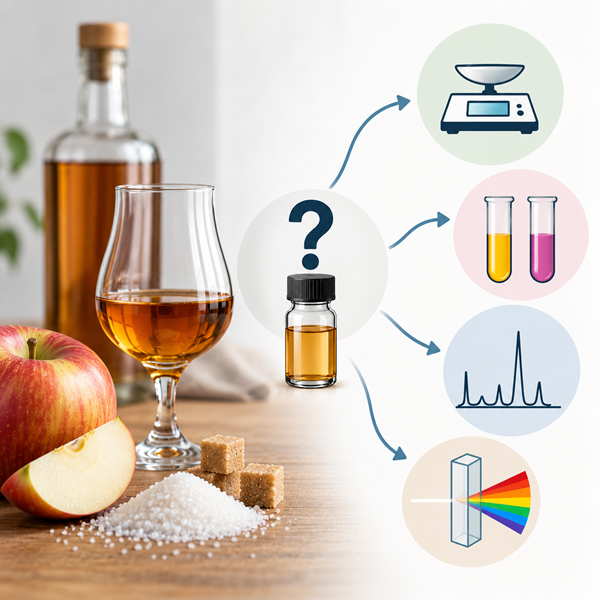
Various methods are available to determine sugar content in spirits, differing in specificity, accuracy, speed and cost. This article provides an overview of the sugars found in spirits and practical guidance to help you choose the most appropriate method for in-house quality control.
by evelyne | Sep 27, 2025 | Analysis methods, Production control, Regulation
In quality control, production, or research, comparing analytical results is part of everyday practice.
But what happens when two professionals — each confident in the reliability of their work — observe a discrepancy between their measurements?
It’s a common situation, often leading to tension, misunderstanding… or rushed decisions.
Example: Two laboratories measure the alcohol content of the same spirit sample. One reports 40.1% vol, the other 39.8% vol.
Who’s right? Are the results truly incompatible — or simply different within the range of measurement uncertainty?
This article provides a practical framework to interpret such differences rigorously, understand the role of measurement uncertainty, and assess whether two results can be considered technically consistent.

by evelyne | Jan 21, 2024 | Analysis methods
To measure the alcohol content in a spirit, the official method by distillation is still the most used method because it is the most universal and the least expensive in investment.
There are different types of distillation devices (direct distillation or steam entrainment), more or less automated, but which all have a maximum field of application for measuring the alcohol level.
This article explains how to use the device even if the alcohol level is above its use limit, while obtaining accurate results using appropriate methodology.

by evelyne | Jan 17, 2024 | Analysis methods
To meet internal production control requirements, this article presents the various methods and equipment for measuring the alcohol content in alcoholic beverages.
It guides you in choosing the most suitable method based on your objectives, whether in terms of the type of beverage to be analyzed, the desired result accuracy, response time, frequency of analysis, operator qualifications, or budget constraints linked to investment and operation.
by evelyne | Jan 17, 2024 | Alcoholometry, Analysis methods, Production control
The official method for determining the alcohol content of a spirit requires prior distillation to eliminate residues that could distort the density measurement. However, distillation does not completely eliminate all volatile compounds other than ethanol.
What about measurements made with automatic or semi-automatic devices, very selective for the analysis of ethanol, such as near infrared analyzers?