Production control

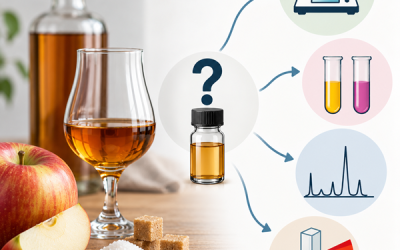
When two analytical results don’t match: How to approach discrepancies ?

When two analytical results don’t match: How to approach discrepancies ?

In quality control, production, or research, comparing analytical results is part of everyday practice.
But what happens when two professionals — each confident in the reliability of their work — observe a discrepancy between their measurements?

It’s a common situation, often leading to tension, misunderstanding… or rushed decisions.
Example: Two laboratories measure the alcohol content of the same spirit sample. One reports 40.1% vol, the other 39.8% vol.
Who’s right? Are the results truly incompatible — or simply different within the range of measurement uncertainty?

This article provides a practical framework to interpret such differences rigorously, understand the role of measurement uncertainty, and assess whether two results can be considered technically consistent.

read more
Best Practices for Using Portable Digital Density Meters

Best Practices for Using Portable Digital Density Meters

Portable digital density meters calculate alcohol content at 20 °C from density and temperature.
Compact and robust, they are ideal for quick measurements in the field — in cellars, tank rooms, or at the base of transport containers.
This guide will help you achieve reliable results, avoid common errors, and get the most out of your equipment.

read more
Best Practices for Spirits Tasting

Best Practices for Spirits Tasting

Tasting is a key quality control tool for spirits, but to ensure reliable and reproducible results, certain best practices are essential, especially for eaux-de-vie derived from fermented products. From the tasting environment to sensory evaluation methods, discover the recommendations for an optimal and rigorous analysis.

read more
Consequences of Climate Change on the Quality and Stability of Spirits – Part 1: Fermentation

Consequences of Climate Change on the Quality and Stability of Spirits – Part 1: Fermentation

Climate change spares no domain, and the production of spirits, especially their aging in barrels, is no exception. The influence of climate variations on the organoleptic properties and stability of finished products is becoming a key concern for quality-conscious producers.
To understand the impacts of climate change, it is essential to revisit the origin of the compounds that form the very essence of spirits. Since only volatile compounds from the fermented matter remain in the distillate after distillation, this first article focuses on the origin and organoleptic impact of these compounds.

read more
Alcohol content measurement – Part 3 : Distillation with dilution

Alcohol content measurement – Part 3 : Distillation with dilution

To measure the alcohol content in a spirit, the official method by distillation is still the most used method because it is the most universal and the least expensive in investment.
There are different types of distillation devices (direct distillation or steam entrainment), more or less automated, but which all have a maximum field of application for measuring the alcohol level.
This article explains how to use the device even if the alcohol level is above its use limit, while obtaining accurate results using appropriate methodology.

read more
Alcohol Content Measurement – Part 1: Principle, Equipment, Selection Criteria

Alcohol Content Measurement – Part 1: Principle, Equipment, Selection Criteria

To meet internal production control requirements, this article presents the various methods and equipment for measuring the alcohol content in alcoholic beverages.
It guides you in choosing the most suitable method based on your objectives, whether in terms of the type of beverage to be analyzed, the desired result accuracy, response time, frequency of analysis, operator qualifications, or budget constraints linked to investment and operation.

read more
Alcohol content measurement – Part 2 : Distillation or Infrared

Alcohol content measurement – Part 2 : Distillation or Infrared

The official method for determining the alcohol content of a spirit requires prior distillation to eliminate residues that could distort the density measurement. However, distillation does not completely eliminate all volatile compounds other than ethanol.
What about measurements made with automatic or semi-automatic devices, very selective for the analysis of ethanol, such as near infrared analyzers?

read more
Alcohol Contraction or Dilatation with temperature

Alcohol Contraction or Dilatation with temperature

During a temperature increase, volume of alcohols expands or conversely, during a temperature decrease, the volume contracts. The higher the alcohol content, the more pronounced this phenomenon becomes.
In the field of spirits, during production, for inventory management and bulk transactions, the measured volume can vary significantly due to temperature fluctuations. Therefore, it is essential to convert the measured volumes to 20°C for accuracy.
So how to calculate the volume at 20°C ?

read more
Volatile Substances

Volatile Substances

The definition of Volatile Substances was revised in 2000 in a European regulation.
For some types of spirits, the sum of volatile substances is standardized: refer to the European Regulation of Spirits Drinks in force, to the specific specifications of some appellations, or to the regulations or specifications imposed by the importing country.
This article includes the definition, the calculation and the official methods of analysis of these substances.

read more