by evelyne | Sep 10, 2026 | Analysis methods, Constituents, Production control
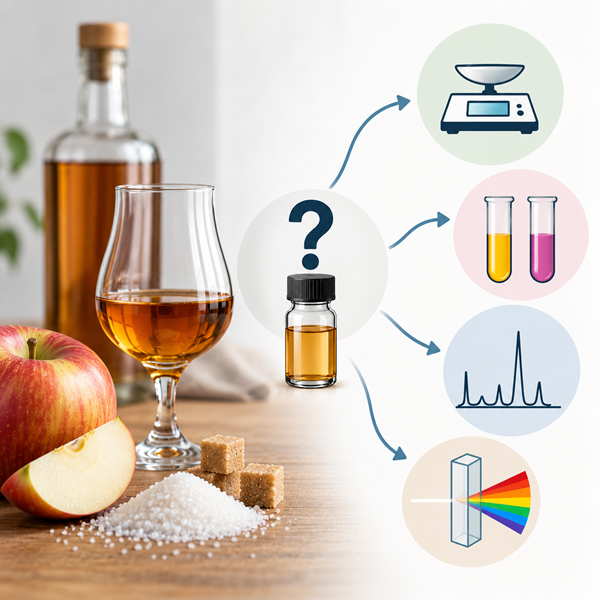
Various methods are available to determine sugar content in spirits, differing in specificity, accuracy, speed and cost. This article provides an overview of the sugars found in spirits and practical guidance to help you choose the most appropriate method for in-house quality control.

by evelyne | Nov 6, 2025 | Bottling, Production
Aluminum, malleable, lightweight, recyclable, and safer than glass, is widely used for beverage cans. Its resistance to corrosion depends in part on the quality of the protective internal coating. When this coating presents defects in application or uniformity, corrosion can develop, particularly in the presence of sugar.
This article explains the mechanisms involved and proposes a protocol to evaluate the quality of can coatings.
by evelyne | Sep 27, 2025 | Analysis methods, Production control, Regulation
In quality control, production, or research, comparing analytical results is part of everyday practice.
But what happens when two professionals — each confident in the reliability of their work — observe a discrepancy between their measurements?
It’s a common situation, often leading to tension, misunderstanding… or rushed decisions.
Example: Two laboratories measure the alcohol content of the same spirit sample. One reports 40.1% vol, the other 39.8% vol.
Who’s right? Are the results truly incompatible — or simply different within the range of measurement uncertainty?
This article provides a practical framework to interpret such differences rigorously, understand the role of measurement uncertainty, and assess whether two results can be considered technically consistent.

by evelyne | Apr 19, 2025 | Alcohol Inventories, Alcoholometry, Analysis methods, Maturation, Production control
Portable digital density meters calculate alcohol content at 20 °C from density and temperature.
Compact and robust, they are ideal for quick measurements in the field — in cellars, tank rooms, or at the base of transport containers.
This guide will help you achieve reliable results, avoid common errors, and get the most out of your equipment.

by evelyne | Jan 23, 2024 | Alcoholometry, Blending, Production
When diluting a hydroalcoholic mixture with water, the final volume is lower than the sum of the volume of water + the starting volume.
This article explains its origin. He presents a study which demonstrates that in the case where analysis by distillation requires dilution, it is nevertheless possible to obtain good precision in the measurement of the alcohol level.