This blog offers technical articles dedicated to spirits professionals
and written in collaboration with our network of experts.
It is designed to allow you to navigate through various topics.
New articles will be regularly added.

When alcoholometric tables reveal their poetic side
When Alcoholometric Tables Reveal Their Poetic Side
By analysing the differences between successive correction values for alcoholic strength by volume (ABV), curved lines emerge, resembling botanical patterns.
These unexpected patterns result from the combination of the complex physical properties of ethanol–water mixtures and the rounding rules used to construct the tables.
Beyond their distinctive beauty, these graphical representations can also reveal anomalies in published tables and open up new avenues for scientific investigation.
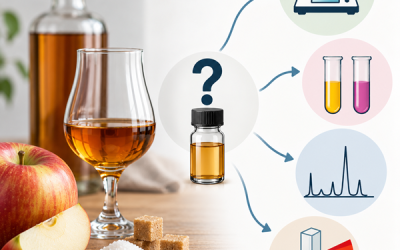
Controlling the sugar content of your alcoholic beverages: Which method should you choose?
Various methods are available to determine sugar content in spirits, differing in specificity, accuracy, speed and cost. This article provides an overview of the sugars found in spirits and practical guidance to help you choose the most appropriate method for in-house quality control.

Phenolic compounds from wood in spirits: understanding, measuring, and choosing the right analytical method
This article reviews the origin of the main wood-derived phenolic compounds, their impact during ageing, and the analytical methods available to measure them. Its objective is to help you select the most appropriate tools for your quality control and production monitoring needs.

How sugar contributes to aluminum beverage can corrosion
Aluminum, malleable, lightweight, recyclable, and safer than glass, is widely used for beverage cans. Its resistance to corrosion depends in part on the quality of the protective internal coating. When this coating presents defects in application or uniformity, corrosion can develop, particularly in the presence of sugar.
This article explains the mechanisms involved and proposes a protocol to evaluate the quality of can coatings.
When two analytical results don’t match: How to approach discrepancies ?
In quality control, production, or research, comparing analytical results is part of everyday practice.
But what happens when two professionals — each confident in the reliability of their work — observe a discrepancy between their measurements?
It’s a common situation, often leading to tension, misunderstanding… or rushed decisions.
Example: Two laboratories measure the alcohol content of the same spirit sample. One reports 40.1% vol, the other 39.8% vol.
Who’s right? Are the results truly incompatible — or simply different within the range of measurement uncertainty?
This article provides a practical framework to interpret such differences rigorously, understand the role of measurement uncertainty, and assess whether two results can be considered technically consistent.

Liqueur, Cocktail, and Cream Recipes:
Anticipating the Effect of Sugar on the Final Alcohol Content
When making a sweet alcoholic drink (liqueur, cocktail, cream, etc.), calculating the final alcohol content might seem as simple as adding up the volumes of alcohol, water, and sugar. But once sugar dissolves, it takes up space — and that extra volume can throw the math off.
👉 Can we really predict the final ABV from the starting ingredients alone?
👉 And why does sugar make the calculation so tricky?
It all comes down to how sucrose behaves in a water–ethanol mix — a process still not fully understood.
To shed light on this, we teamed up with Labox Applications to:
Measure the actual volume that dissolved sugar occupies in different mixtures,
Explore the dissolution process in water and ethanol,
Test whether the final ABV can be calculated accurately.
Full results in the article.

Best Practices for Using Portable Digital Density Meters
Portable digital density meters calculate alcohol content at 20 °C from density and temperature.
Compact and robust, they are ideal for quick measurements in the field — in cellars, tank rooms, or at the base of transport containers.
This guide will help you achieve reliable results, avoid common errors, and get the most out of your equipment.

Consequences of climate change on the quality and stability of spirits – Part 3
Wood maturation is a highly complex process, and many of its mechanisms remain only partially understood. Today, spirits professionals are increasingly concerned about how climate change may impact evaporation rates and the overall quality of barrel-aged eaux-de-vie. Can we anticipate and mitigate these effects?
This article outlines key insights into the ageing process, the challenges posed by global warming, and possible strategies to adapt—reducing evaporation while preserving the quality of the spirit.

Best Practices for Spirits Tasting
Tasting is a key quality control tool for spirits, but to ensure reliable and reproducible results, certain best practices are essential, especially for eaux-de-vie derived from fermented products. From the tasting environment to sensory evaluation methods, discover the recommendations for an optimal and rigorous analysis.

OPTIMIX: A Blending Optimization Tool
Discover how OPTIMIX, an innovative application, is revolutionizing the art of blending by optimizing your creations through a detailed analysis of your stock of product and your qualitative and quantitative objectives

Consequences of climate change on the quality and stability of spirits – Part 2: Distillation
After discussing the origin of volatile aromatic compounds in fermented raw materials, this second article focuses on the role and importance of distillation control in achieving the desired eau-de-vie quality.
The final part of this series explores the key physicochemical changes that eaux-de-vie undergo during barrel aging.
This three-part series will conclude with an analysis of the impact of climate change on the composition of barrel-aged eaux-de-vie and the measures that can be implemented to maintain quality control