Whether for production control or to comply with regulatory requirements, determining sugar content is a common concern for producers who wish to have an in-house control method.
To select the appropriate method, it is important to know which types of sugars need to be measured and for what purpose.
Indeed, different methods are available, varying in their specificity, accuracy, speed and implementation cost.
Before discussing the measurement methods, this article describes the main sugars that may be found in spirits, their origin, their relative sweetness and their concentration ranges.
Which sugars are found in spirits, and where do they come from?
The main sugars found in spirits are sucrose, glucose and fructose.
– Sucrose is not naturally present in spirits. It comes from added cane or beet sugar.
In an acidic alcoholic medium, sucrose is progressively hydrolysed into glucose and fructose.
– During ageing in wood, small amounts of glucose may be extracted from the wood. They mainly result from the degradation of hemicelluloses during wood toasting and, to a lesser extent, from the very slow hydrolysis of cellulose.
– Depending on how they are produced, liquid wood extracts may also contribute glucose.
– The use of previously used casks that have contained sweet products, such as fortified wines like Port or Pineau, or naturally sweet wines such as Sauternes, may allow the spirit to take up sucrose, glucose and fructose.
– Macerations of plants or fruits, as well as the addition of honey, are also sources of sugars, mainly glucose and fructose, sometimes with small amounts of sucrose and maltose.
– Maltose may also be introduced through the addition of certain glucose syrups, while lactose may be present in spirits containing cream or milk.
Note:
– The selective evaporation of water and alcohol during ageing results in the concentration of glucose extracted from the wood, which may reach 1–2 g/L.
– In most regulatory texts, Total sugars = Sucrose + Glucose + Fructose, expressed as sucrose.
Relative sweetness of the different sugars
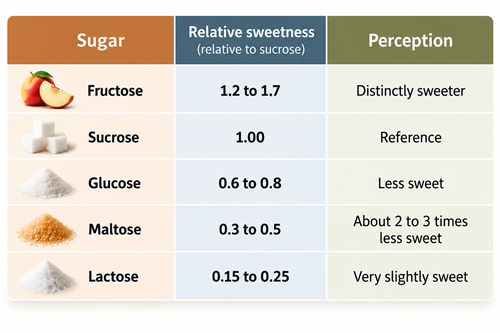
Taking the relative sweetness of sucrose as the reference (sucrose = 1.00), there are significant differences between sugars, as illustrated in Figure 1.
Figure 1
Note:
These values are approximate: perceived sweetness varies depending on concentration, temperature, the matrix and the presence of other compounds.
Example: Pectins can enhance the sensation of roundness and modify the perception of sweetness. This is particularly the case for products made from slightly clarified or unclarified apple juice, especially since fructose, which is generally the predominant sugar, has a high relative sweetness.
Concentration ranges of the different sugars
The concentration range is very broad, from 0 to several hundred g/l depending on the classification of the spirit.
Examples:
– French appellations (Cognac, Armagnac, Calvados, Lambig, etc.):
Production specifications limit total sugar content by setting a maximum obscuration of 4% vol. For a product at 40% vol., this corresponds to approximately 16 g/L of total sugars (*).
– Rums:
European regulations limit the sweetening of rum to 20 g/L (1), without reference to a specific alcohol content (). Some production specifications, such as those for AOC Rhum de la Martinique (2), impose a more restrictive limit based on a maximum obscuration of 4% vol., also without reference to a specific alcohol content (*).
Rums produced outside the European Union are not subject to these provisions and may have much higher sugar contents.
– Whiskies:
European regulations prohibit sweetening. However, small amounts of glucose (up to 1 g/L) may be present as a result of extraction from the wood.
When ageing takes place in casks that previously contained a sweet or fortified wine (Port, Sherry, Madeira, etc.), sugars may also come mainly from residual liquid retained in the staves and in the first layers of the wood.
Indeed, considering that:
• cask sizes typically range from 225 to 600 L;
• 1 to 3 litres of product may remain in the staves of a cask;
• the product may contain at least 100 to 150 g/L of sugars;
⇒ the cask may contribute between 100 and 450 g of sugars. This represents a final contribution of approximately 1 to 2 g/L for a 225 L cask and 0.5 to 1 g/L for a 600 L cask.
This type of finishing is also used for other spirits, such as brandy and Tequila.
– Flavoured spirits:
Total sugar contents vary considerably, ranging from a few g/L to several tens of g/L.
– Liqueurs and crèmes:
According to European regulations:
• liqueurs must contain more than 100 g/L of total sugars;
• crèmes must contain more than 250 g/L;
• certain crèmes (such as crème de cassis) must contain more than 400 g/L.
(*) Relationship between obscuration and sugar content
See the blog article “Degree of obscuration”, which explains what obscuration represents, and the Boxette “Dry extract and Obscuration”, which can be used to estimate sugar content from the actual alcohol content and apparent alcohol content, or from density.
This estimation remains valid provided that the other permitted ingredients make a negligible contribution to the obscuration.
This is particularly the case for caramel when used in small quantities to adjust colour.
Examples: An obscuration of 4% vol. corresponds to approximately 16 g/L of total sugars for a product at 40% vol. alcohol and 21 g/L for a product at 55% vol. alcohol.
The different methods for analysing sugars in spirits
Depending on the type of sugars to be analysed, the concentration range to be covered and the equipment available, methods range from the simplest and least expensive to the most specific, but also more costly:
- Calculation based on obscuration, which corresponds to the difference between the actual alcoholic strength by volume (ASVr) and the apparent alcoholic strength by volume (ASVb). See the article on this blog: “Obscuration”.
- Specific calculation based on the actual alcoholic strength by volume (ASVr) and density. This method is equivalent to the previous one, since density is related to the apparent alcoholic strength by volume (ASVb).
- Determination of total dry extract by gravimetry – OIV method (OIV-MA-BS-09: R2009). It consists in evaporating the volatile constituents of the sample and then weighing the non-volatile residue after drying. This method applies to spirit drinks of vitivinicultural origin containing less than 15 g/L of dry matter.
- Determination of total dry extract by calculation – OIV usual method (OIV-MA-BS-10: R2009). The dry extract is determined indirectly from the density of the alcohol-free residue, itself calculated from the density of the beverage and that of the corresponding hydroalcoholic mixture.
- Colorimetric methods are based on a chemical reaction producing a colour whose intensity, measured by spectrophotometry, is related to the sugar concentration. Depending on the method used, they can determine reducing sugars or total sugars after hydrolysis.
- Enzymatic methods allow the selective determination of certain sugars, mainly glucose and fructose, as well as sucrose after hydrolysis. A coloured reaction is produced and measured by spectrophotometry.
- Liquid chromatography or capillary electrophoresis methods allow the different sugars, particularly glucose, fructose and sucrose, to be separated and quantified individually. They are particularly useful when it is necessary to determine the sugar composition rather than only the total sugar content.
- Physical methods using near- and mid-infrared spectroscopy (NIR and MIR) allow rapid, reagent-free determination of sugar content based on the sample spectrum and a calibration model previously established for the products being analysed.
The Boxette “Dry Extract and Obscuration” can be used to calculate dry extract from the following parameters: actual and apparent alcoholic strength by volume, or density.
If the actual alcoholic strength by volume is not known, determination of the dry extract is a good alternative. The method is described in the appendix to this article: “Dry Extract Analysis Method”.
Which method should you choose?
Wine or fruit spirits, whiskies, rum, Tequila, Mezcal, brandy, Pisco
Provided that their dry extract consists essentially of sugars, the two calculation methods — obscuration or the specific calculation based on actual alcoholic strength by volume and density — provide a good approximation.
For products with a high sugar content, such as liqueurs
Provided that the dry extract consists predominantly of sugars, dry extract determination will also provide a good estimate, provided that the sample is diluted to keep the sugar concentration below 15 g/L.
For crèmes, plant- or honey-flavoured spirits, or cream-based products
Only specific methods can accurately determine the sugar content.
For this purpose, laboratories generally favour enzymatic methods, which are highly selective, reasonably accurate despite the dilution required, and can be automated. These methods require sucrose to be hydrolysed into glucose and fructose. Specific enzymatic kits can automatically perform this hydrolysis before glucose/fructose determination. Total sugars expressed as sucrose correspond to 95% of the sum of glucose + fructose.
If liquid chromatography or capillary electrophoresis equipment is available, the individual sugars can be determined separately. However, analytical throughput is relatively low.
Some near-infrared instruments used to measure alcoholic strength also offer sugar determination. However, they need to be coupled with a density meter.
Some laboratories equipped with mid-infrared FTIR (Fourier Transform Infrared) analysers have developed specific calibrations. These instruments have the advantage of being multiparametric and suitable for automation, but they are very expensive, costing several tens of thousands of euros.
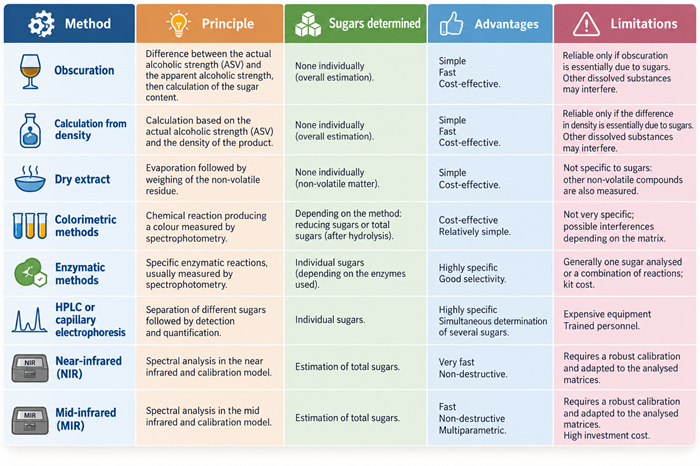
Figure 2 provides a concise overview of these methods, the types of sugars determined, and their advantages and limitations.
Figure 2
Conclusions
This article provides some guidance to help you identify the method best suited to your in-house quality control needs.
When choosing among these different techniques, you will need to consider not only the required accuracy, but also the desired response time, the number and, where relevant, the volume of samples to be analysed within a given period, the operator’s level of qualification, the analytical resources available, etc.

For in-house quality control, are you looking to invest in new equipment or optimise your analytical practices?
In partnership with various suppliers (Dujardin-Salleron, Anton Paar, Foss, Shimadzu, Agilent, etc.), I can assist you in defining and implementing solutions tailored to your project.

And what if, when developing a new recipe, you could maximise your chances of achieving the desired sugar content from the very first trials?
When developing a new product, particularly one containing plants and/or fruits, one of the challenges is to adjust several characteristics of the final product simultaneously: sugar content, alcoholic strength and the proportions of the different ingredients, while complying with formulation constraints.
This is precisely the type of challenge for which Labox Applications has developed a specific Boxette: “Recipe Calculations”. It helps guide the formulation process from the very first trials and maximise your chances of achieving the desired sugar content while simultaneously meeting the other recipe targets, particularly the alcoholic strength. See the article on this blog: “Liqueur, Cocktail, and Cream Recipes – Anticipating the Effect of Sugar on the Final Alcohol Content“.
A more comprehensive solution is available with OPTIMIX. Based on the characteristics of the different ingredients and the targets defined for the final product, this multi-criteria optimisation tool determines the proportions that provide the closest possible match to the desired values. See the article on this blog: “OPTIMIX: A Blending Optimization Tool“.
Dry Extract Analysis Method
The method is described by the OIV. The principle consists in removing the volatile components of the sample by evaporation and then weighing the resulting non-volatile residue.
Equipment:
– Aluminium dish with a capacity of 50 to 100 mL
– Balance with an accuracy of ±0.1 mg. At this level of accuracy, its contribution to the uncertainty of the dry extract determination is very low: approximately 6 mg/L.
Balance accuracy — Impact on dry extract (g/L)
| ± 0,1 mg | ± 0,006 g/L |
| ± 1 mg | ± 0,057 g/L |
| ± 10 mg | ± 0,57 g/L |
| ± 20 mg | ± 1,13 g/L |
| ± 50 mg | ± 2,83 g/L |
| ± 100 mg | ± 5,66 g/L |
Depending on the required level of accuracy, a balance with an accuracy of ±10 mg may be suitable.
– 25 mL volumetric pipette
– Drying oven capable of reaching at least 105 °C
– Desiccator containing activated desiccant
Protocole
- Weigh the empty dish: let n1 be the mass of the empty dish.
- If necessary, dilute the sample to keep the sugar content below 15 g/L.
- Using a volumetric pipette, transfer 25 ml of the sample into the dish.
- Place the dish on the lid of a boiling water bath for the first hour of evaporation, to prevent the liquid from boiling, which could result in losses through splashing. Then leave it for a further hour in direct contact with the steam from the boiling water bath.
- Complete the drying process by placing the dish in an oven at 105 ± 3 °C for two hours. Allow the dish to cool in a desiccator, then weigh the dish and its contents.
An alternative to the OIV method is to place the dish directly in an oven set at 105 ± 3 °C and leave it to evaporate overnight. - Then reduce the oven temperature to 50 °C and quickly transfer the dish to a desiccator containing a desiccant.
- Allow the dish to cool to room temperature in the desiccator for at least 30 minutes before weighing.
This step is important because, if the dry extract has not cooled to room temperature, it may absorb moisture from the air, resulting in an overestimation of its mass.
Calculation of dry extract
For a sample volume of 25 ml: Dry extract (g/L) = (n2 – n1) × 40
If the sample has been diluted beforehand, the result must be multiplied by the dilution factor.
This method involves several critical points: dilution or sampling errors, temporary interruption of the drying oven during the night, incorrect oven temperature, weighing the dish before it has completely cooled, moisture uptake by the residue, etc.
To ensure that the entire method is under control, one solution is to analyse a control sample in parallel, with a known sugar content and, if possible, a concentration close to that of the samples being analysed.
By subjecting the control sample to exactly the same operations, using the same equipment and at the same time as the samples being tested, you can check that the result obtained is consistent with the expected value and thus verify that the analyses have been performed correctly.
Reminder:
Dry extract corresponds to the mass of non-volatile substances present in the spirit.
It can only be considered equivalent to sugar content if the contribution of other non-volatile substances is negligible.
The equipment required to perform this method can be supplied by DUJARDIN-SALLERON.
Evelyne CHANSON – Quality Control Wines and Spirits Consultant at EC Consulting
If you enjoyed this article, would like further information, or have any corrections or comments, please feel free to contact me by email at evelyne.chanson@gmail.com or leave a comment in the section at the bottom of this article.
References cited in the article
(1) 2019 – Consolidated text: Regulation (EU) 2019/787 of the European Parliament and of the Council of 17 April 2019 on the definition, description, presentation and labelling of spirit drinks, the use of the names of spirit drinks in the presentation and labelling of other foodstuffs, the protection of geographical indications for spirit drinks, the use of ethyl alcohol and distillates of agricultural origin in alcoholic beverages, and repealing Regulation (EC) No 110/2008
(2) 2020– Order of 29 December 2020 approving the specifications for the “Rhum de la Martinique” Protected Designation of Origin (AOC) – Official Journal of the French Republic (JORF) No. 0316 of 31 December 2020, Text No. 165 – Amended and/or supplemented by the “Amended specifications for the AOC Rhum de la Martinique, approved by the Order of 29 December 2020, published in the JORF of 31 December 2020 – Official Bulletin No. 03 of 14 January”.
0 Comments